Sustainability at Seegut Zeppelin
This page shows what Seegut Zeppelin does on energy, nature, the supply chain and for our team, and how we document it: with our GreenSign certificate, consumption figures and the names of our partners.
Certification · Everyday · Supply chain · Nature · Our team · Progress · Awards

Our Mission Statement
Responsibility is part of being a host. Seegut Zeppelin aims to be a place where guests can rest and trust that we act sustainably.
That applies to energy, water and food, and to how we work as a team: fair working conditions, access to further training and a workplace where employees help shape what happens. We work with producers, craftspeople and our neighbors as equals. We name trade-offs openly. Growth and conserving resources do not always fit together neatly.
We steer by two recognized frameworks: the Economy for the Common Good and the GreenSign rating system. Both help us measure and disclose our progress, including where we do not yet meet our own standards.
The full mission statement was also submitted in July 2025 as part of our GreenSign certification.
How We Define Sustainability
We follow the themes of the Common Good Balance Sheet: How do we treat our suppliers, our employees, our guests, nature and the community we do business in? We publish what we do in these areas on this page and keep adding to it under “Progress, Documented.”
Certification
Seegut Zeppelin has been audited externally, against one of the more demanding standards in the hotel industry.
The standard is GreenSign Hotel v. 3.2, audited and issued by VERIS Certifications GmbH. The audit on September 24, 2025 confirmed an overall conformity of 83 percent across ten core areas, from energy and water to purchasing and the hotel’s social and economic responsibility. The certificate is valid until May 21, 2028, registration no. 100-01190-2025-10-06-1.
Sustainable meetings explains what this means for conferences and events at Seegut.
Examples from Everyday Operations
Four questions guests ask at Seegut, answered from day-to-day operations.
Where does the water in my room come from?
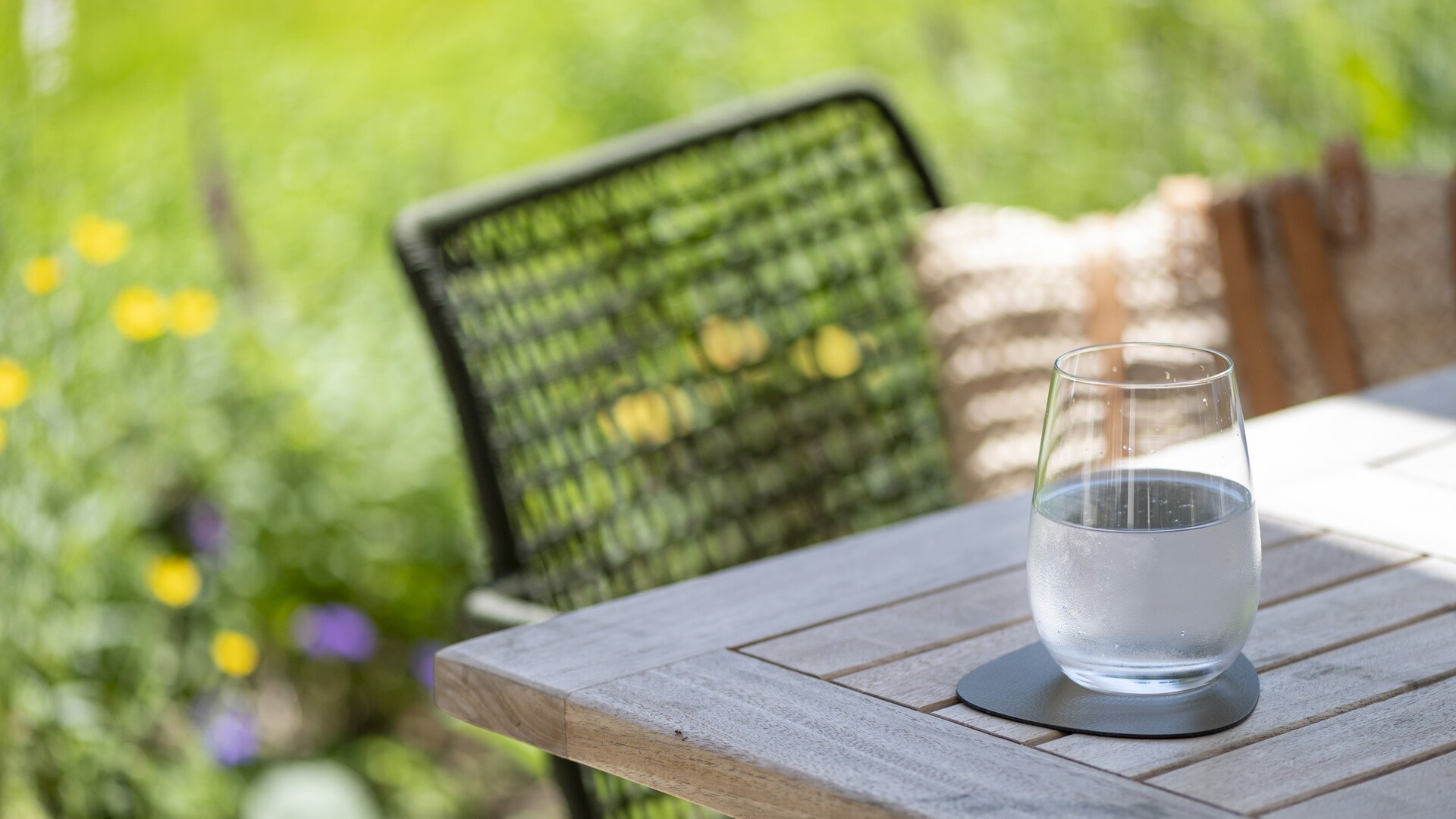
Your room has a glass bottle of still water, free of charge. It's tap water that we bottle here at Seegut, so no crates of bottled water are trucked in, and each bottle is washed and refilled. If you'd like another one, just let the front desk know.
How often are towels and bed linen changed?
We replace any towels you leave on the floor. Towels on the hook stay where they are. Bed linen is changed on request; just let the front desk know.
Where does Seegut get its electricity and heat?
Our newer buildings are heated with geothermal energy: heat pumps draw warmth from the ground and run on electricity. Only Villa Gminder still uses a gas boiler. Our electricity comes from a standard supply contract; we don't have a green power tariff at the moment. The underground garage has four EV charging points (Type 2, 11 kW) at 0.55 euros per kWh, paid right at the charger by card or phone. E-bikes can be charged in the bike room.
How do I get to Seegut without a car?
From Friedrichshafen Stadt station, bus lines 100 and 7395 run to the Fischbach West stop, just a short walk from Seegut. Friedrichshafen-Fischbach station is about half a mile away, and from the airport the RB91 train takes you to Friedrichshafen Stadt. When you check in, you'll receive the Echt Bodensee Card free of charge, which lets you ride buses and trains in the bodo network at no cost during your stay. You can leave your bike in the bike room or at the bike racks outside the front desk and the villa.
Supply Chain and Region
What comes to the table in the morning
At breakfast and in the Pinus kitchen, we know where our products come from. The cheese comes from Käserei Bauhofer in Bodnegg, vegetables from Biohof Hutt in Friedrichshafen-Ailingen and from Bio-Mayer Gemüsebau nearby. Potatoes and eggs also come from Biohof Hutt, meat from Fairfleisch in Überlingen, honey from Imkerei BlinkaBelle in Friedrichshafen-Raderach and coffee from Kaffeerösterei Hensler in Lindau. Whenever possible, fish is wild-caught in Lake Constance. Seegut Zeppelin is a member of Bodenseefisch e.V.
Root to leaf at Pinus
At Pinus, vegetables are used from root to leaf. Head chef Michel Franck calls it root to leaf. In the kitchen it means throwing nothing away that can still be used. The vegetable-led menu is served family style, for sharing. Pinus holds a MICHELIN Bib Gourmand and 6 Gusto pans, is recommended in the Slow Food Genussführer and has the Three Lions of Schmeck den Süden, the initiative’s highest rating.
Nature and the Global Community
Villa Gminder was built in 1908 by Theodor Fischer and sits in a ten-acre landscape park right on the shore of Lake Constance. Old trees were preserved when the new buildings were planned. We use no pesticides or synthetic fertilizers, and shelters for wildlife were created on purpose. The park is kept dark at night to protect nocturnal species. Selected glass surfaces carry bird-safe markings. In 2026, the operating family received the Bodenseegärtenpreis from the Netzwerk Bodenseegärten for its care of the historic park, in the category Environmentally Conscious Gardening. In the GreenSign audit, the core area Biodiversity and Cultural Heritage scored 100 percent.
A certifier from the Netzwerk Bodenseegärten inspected the landscape park on site: no pesticides, no synthetic fertilizers, no peat. Since then, the park has carried the “Natur im Garten” award and is publicly listed among the certified gardens around Lake Constance.
Some rooms have a nature guide and binoculars ready for guests. The paths in the park are lit with insect-friendly lights that switch on only by motion sensor.
From December 2024 to November 2025, Seegut Zeppelin used 183,579 kilowatt hours of electricity, an annual average of 12.3 kilowatt hours per room night. Natural gas and water are billed annually: from May to December 2024, consumption was 20,390 kilowatt hours of natural gas and 2,378 cubic meters of water, or 2.99 kilowatt hours of gas and 0.349 cubic meters of water per room night. The new buildings are heated with geothermal energy via heat pumps, Villa Gminder with gas.
Our Team
Good hosts need a house that takes care of them. At Seegut Zeppelin, employment contracts are generally permanent. Pay is above the collective agreement, with vacation and Christmas bonuses under the agreement and tax-free premiums. Employees receive two days of vacation on top of the collective agreement, plus one paid day for volunteer work. Staff meals are cooked with fresh, fair and partly organic ingredients. The house provides financial support to employees looking for housing or childcare. Learn more on our careers page.
Progress, Documented
This is where we record what changes. Step by step, each entry documented.
October 2026: Ark of Taste trees in the orchard. In October 2026, Seegut Zeppelin is planting new trees in its meadow orchard, using only varieties from the Slow Food Ark of Taste. The kitchen and garden also use wild herbs and fruit from the grounds: sloe, sea buckthorn, hazelnut, rowan and walnut, plus harvests from raised beds and the greenhouse.
August 2026: Pinus earns Three Lions from Schmeck den Süden. Pinus has been awarded the Three Lions, the highest rating of Schmeck den Süden. The certificate is on file.
July 2026: Bodenseegärtenpreis 2026. Seegut Zeppelin received the Bodenseegärtenpreis for its care of the historic landscape park.
December 2024 to November 2025: 12.3 kWh per room night. 183,579 kWh of electricity over this period equals 12.3 kWh per room night. No green power contract.
October 6, 2025: GreenSign Hotel v. 3.2, 83%. Externally audited by VERIS Certifications GmbH.
2025: Landscape park certified: Natur im Garten. No pesticides, no synthetic fertilizers, no peat.
June 2024: Beehives in the garden. Since June 2024, BlinkaBelle has kept bee colonies in the Seegut Zeppelin garden. You can buy the honey in our in-house shop.
May 2024: Root to leaf at Pinus. At Pinus, vegetables are used from root to leaf.
May 2024: Cheese from Käserei Bauhofer. The cheese at Pinus comes from Käserei Bauhofer in Bodnegg.
May 2024: Vegetables from Biohof Hutt. Vegetables, potatoes and eggs come from Biohof Hutt in Friedrichshafen-Ailingen.
May 2024: Bird protection and binoculars for guests. Selected glass surfaces carry bird-safe markings. Some rooms have guides to local bird species and binoculars ready for guests.
May 2024: Insect-friendly outdoor lighting. Outdoor lighting is insect-friendly and motion-activated to avoid light pollution along the shore.
May 2024: The eastern part of the park is left alone. This part of the park is not cultivated and generally off limits, which protects it from overuse.
May 2024: Permanent employment contracts as standard. Seegut Zeppelin offers its employees permanent contracts as a rule.
May 2024: Above-standard pay and benefits. Employees receive pay above the collective agreement, vacation and Christmas bonuses under the agreement and tax-free premiums for night, Sunday and holiday work, plus two extra vacation days beyond the agreement.
May 2024: A day off for volunteering. Employees who volunteer receive one additional paid day off per year.
May 2024: Fresh, fair and organic staff meals. Employees receive free or discounted meals made with fresh, fair and organic ingredients.
May 2024: Support with childcare and housing. The house provides financial support for childcare costs and for finding housing.
Wild-caught fish from Lake Constance where possible. Seegut Zeppelin supports Bodenseefisch e.V. and sources wild-caught fish from Lake Constance whenever it can. Fish stocks and the small share of fish on the menu set the limits.
Awards and Memberships
- GreenSign Hotel v. 3.2, 83%: Externally audited by VERIS Certifications GmbH, valid until May 21, 2028.
- Bodenseegärtenpreis 2026: Netzwerk Bodenseegärten, category Environmentally Conscious Gardening.
- Natur im Garten: On-site certification of the landscape park, no pesticides, no synthetic fertilizers.
- Three Lions, Schmeck den Süden (Pinus): The initiative’s highest rating.
- Bib Gourmand, MICHELIN Guide (Pinus): For carefully prepared food at a moderate price.
- Gusto, 6 pans (Pinus): Rating in the Gusto restaurant guide.
- Slow Food Genussführer (Pinus): Recommended in Slow Food Germany’s restaurant guide.
- Member of Bodenseefisch e.V.: An association of professional fishers, restaurateurs and distributors on Lake Constance.